Soil around your home soaks up rain like a sponge. When it saturates, the water in it presses outward in every direction, including against the edge of your slab and the bottom of your walls, a force called hydrostatic pressure.
Service · Chula Vista, CA
Foundation Seepage and Wall Leaks in Chula Vista, CA
A damp stripe is spreading along the base of an outside wall, or your carpet edge turns wet every time it rains with no spill in sight. Foundation seepage and wall leaks come from the ground: rain-saturated soil presses water against your slab and wall bases until it finds a seam to push through. Pull rugs and boxes back from the wet edge, keep it uncovered, and call to describe where the water appears in your Chula Vista home.
What you are seeing
Wet edges that show up only after rain
Ground seepage has a pattern: it starts during or after rain and appears at the lowest, outermost edges of your floor. Check along the outside walls for:
- Damp baseboards
Swollen or darkened trim along walls that face the yard.
- A wet carpet edge
A strip of damp carpet along the tack strip with dry carpet beyond it.
- Water at a crack
A hairline crack in tile or bare concrete that darkens or shines.
- Stucco base staining
Dark, wet patches on the outside wall just above the soil.
If water is creeping in at the base of an outside wall, pull things back from the wet edge and call to describe where it appears.
(619) 927-7782How it works
Pressure from the soil side
Concrete has weak points that let that water through: shrinkage cracks, the joint where the slab meets its perimeter footing, and gaps around pipes that pass through it. Soil or mulch heaped against the stucco above its base screed can also feed water behind the wall finish.
Technique
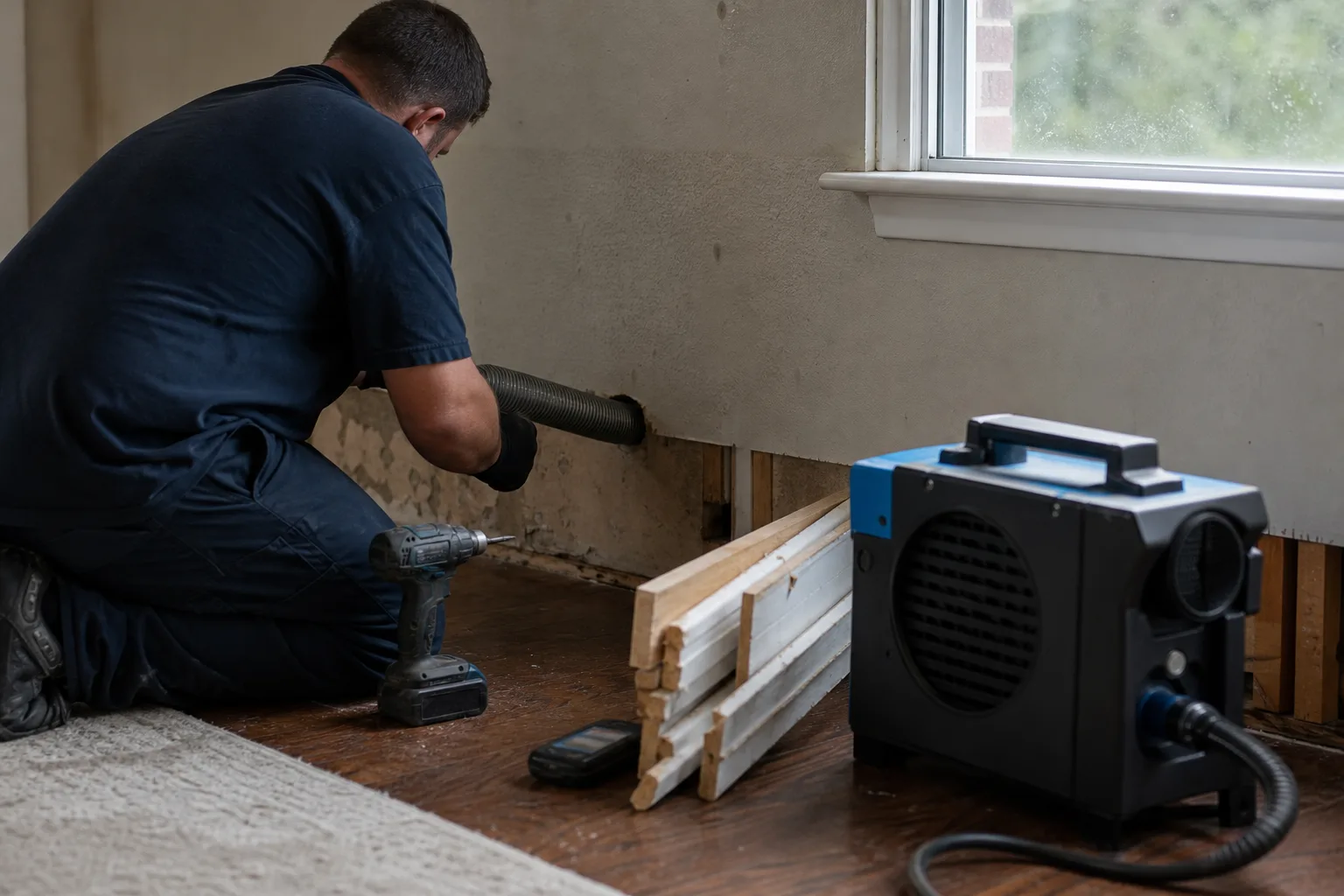
Mapping and drying the seep line
- Perimeter readings
Moisture readings along every outside wall base show where seepage starts and stops.
- Trim and tack strip removal
Wet baseboard and carpet tack strip come up so the slab edge and wall base can dry.
- Edge drying
Air movers aimed along the wall line and a dehumidifier pull water from the slab perimeter and bottom plate.
- Entry-point notes
Each crack or joint that shows water gets a mark and a photo for whoever handles the drainage.
Sealing cracks, regrading soil and adding drainage are foundation and drainage work, separate from the drying. Keep the moisture map with your records so that contractor sees where water entered.
Local detail
Slab edges on postwar lots
Much of west Chula Vista was built out in the 1950s through the 1970s on slab-on-grade foundations, so your floor sits close to the soil outside. When the yard holds water after a storm, check the walls on the side where the ground slopes toward the house and describe that slope on the call.
Phase order
Seepage follows the ground, not the clock
Unlike a burst pipe, ground seepage can keep feeding water as long as the soil stays saturated, so it may continue after the rain stops. Drying the slab edge works best once the soil has had a chance to drain.
The order runs from turning surface water away from that side of the house, to pulling wet trim and carpet edges, to drying with readings along the whole wall line. If readings climb again after the next storm, the entry point still needs drainage work.
Triage order
Ground seepage or a line under the floor
Seepage tracks the weather: it starts with rain, stays near the outside walls and fades as the soil dries. Water that appears in dry weather, or a warm patch in the middle of the floor, points to a plumbing line under the slab instead, so mention which pattern you see.
Scope: Emergency extraction and structural drying clearance only. Structural rebuild and finishing carpentry are contracted separately.
Service area
Chula Vista ZIP codes
- 91909
- 91910
- 91911
- 91912
- 91913
- 91914
- 91915
- 91921
Every responding technician is independent. Before work begins, confirm the technician's license, insurance and pricing with them directly.
Common questions
Seepage and wall leak questions
Can you seal the crack from inside to stop the water?
A patch on the inside rarely holds against water pushed from the soil side. Leave the crack exposed so it can dry and show on the moisture map, and let the drainage fix address the outside.
Why does the seepage come back with every storm?
The soil around that wall saturates each time it rains. Until the grade, gutters or drainage on that side change, the same pressure finds the same joint.
Do you need to move furniture away from the wall?
Yes. Pull it a short distance from the wet edge so air reaches the baseboard, and lift anything made of cardboard or fabric off the floor.
What should you share about seepage on a San Diego County call?
Say which walls get wet, whether it happens only with rain, how the yard slopes, and whether any downspout empties near that wall.
Water damage keeps spreading until it is dried.
Call and describe the damage in Chula Vista: where the water came from, what is wet and how long it has been there.