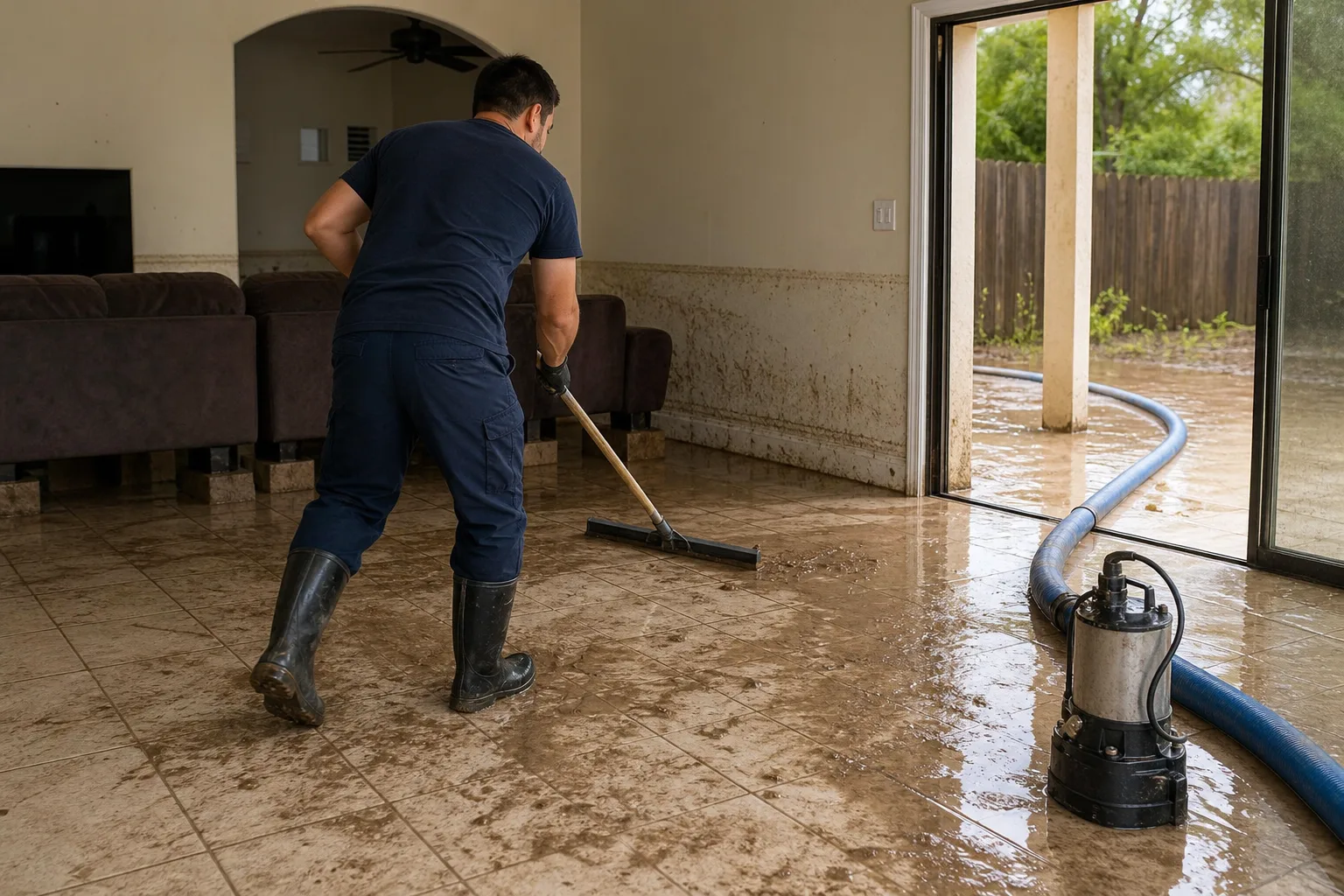
Rain falls clean, but once it crosses a yard, a street or a storm drain it carries soil, oil, animal waste and sometimes sewage. Treat any storm water on your floor as contaminated, and wear boots and gloves around it.
Service category · Chula Vista, CA
Storm and Flood Damage in Chula Vista, CA
Rain is coming through your ceiling, runoff is pushing in under a door, or a wall feels damp after the storm has passed. Storm and flood damage reaches your home from above, from the side and from the ground, and each path calls for a different first move. Keep clear of water near outlets, lift what you can off the floor, and call to describe where the water came into your Chula Vista home.
What you are seeing
Find where the storm got in
Storm water reaches a house by one of four paths, and each one changes what you do first. Match what you see to one of these:
- From above
A drip or a sagging stain on the ceiling while it rains points to the roof. Put a bucket under it and clear the room below any sag.
- Through the openings
Water on a window sill or in front of a door means wind is driving rain past the seals. Lay towels and roll rugs back.
- Across the ground
Runoff pushing under a door or a street drain bubbling up means outside water is coming in. Lift belongings and keep out of moving water.
- Up from the slab
Damp carpet edges or wet baseboards along outside walls after rain point to ground seepage. Pull furniture back from the wet edge.
Choose your situation
Choose the situation that matches yours
- Flood Damage RestorationMud on the floor and a waterline on the walls: floodwater from outside calls for the Category 3 protocol from the start.
- Roof Leak Water DamageDrips during rain, a bowing seam or a stain that grows with each storm: water from the roof is loading your ceiling.
- Flash Runoff and Storm Drain OverflowGutters running full, a curb inlet bubbling up or a patio pond edging toward the slider: runoff is looking for your lowest door.
- Foundation Seepage and Wall LeaksA damp stripe along an outside wall or water at a floor crack after rain: the soil is pushing water in at the slab edge.
- Flash Flood CleanupDeep standing water and debris jammed against your doors after a cloudburst: get safe first, then get the water out.
- Window and Door Leaks in StormsRain on the inside of the glass, a pooling sill or a puddle at the slider: wind is driving water past your seals.
- Water in the Walls After a StormA damp smell, cool drywall or stucco that stays dark after rain: storm water may be trapped inside the wall cavity.
If storm water is coming in right now, stay clear of wet outlets, catch what you can, and call to describe where it enters.
(619) 927-7782Safety protocol
Outside water is dirty water
If water reaches outlets, cords or the electrical panel, stay out of that room and mention it on the call so the restoration crew can plan a safe power shutoff. Leave the house and call the gas utility from outside if you smell gas.
Triage order
Your first moves while the rain keeps falling
Stay clear of outlets
Keep everyone out of any room where water touches outlets or cords.
Lift and move
Carry electronics, papers and boxes off the floor and away from the entry point.
Catch the water
Set buckets under drips and lay towels along sills and thresholds.
Photograph first
Take pictures of the water, the entry point and the waterline before you clean anything.
Leave the materials
Keep wet drywall, carpet and baseboards in place until someone takes moisture readings.
How it works
Why storm damage outlasts the storm
Storm water keeps moving after the sky clears. It wicks up drywall, leaves silt inside the base of your walls and soaks into the edge of your slab, so the damage grows where you cannot see it.
Water that got in from above or through a wall cavity may take a while to show on the surface. A stain, a musty smell or a cool patch on a wall can be your first sign of water that entered during the storm.
Local detail
Most of the rain in a handful of storms
Chula Vista gets most of its yearly rain from a few winter storms, often atmospheric rivers that drop heavy rain over a short stretch. Ground baked hard through the dry months sheds that water as runoff instead of soaking it up, so watch your low doors, downspouts and patio during the first big storm of the season.
Drying metrics
Storm water or a plumbing leak?
Timing tells you a lot. Water that appears only during or right after rain, and fades when the weather dries, points to the roof, the openings or the ground; water that shows up in dry weather points to a plumbing line.
Say which pattern you see when you call. A storm leak needs its outside opening closed, and a plumbing leak needs its line shut off, before any drying can hold.
Triage order
Why a call before the next band of rain matters
Winter storms often come in a run, and each new band adds water to materials that never dried from the last one. Every round soaks more drywall, more insulation and more of the slab edge.
When you call promptly, extraction and drying can begin while the water still sits close to where it came in. Catch what you can, keep clear of wiring, and call to describe the storm damage in your Chula Vista home.
Scope: Emergency extraction and structural drying clearance only. Structural rebuild and finishing carpentry are contracted separately.
Service area
Chula Vista ZIP codes
- 91909
- 91910
- 91911
- 91912
- 91913
- 91914
- 91915
- 91921
Every responding technician is independent. Before work begins, confirm the technician's license, insurance and pricing with them directly.
Common questions
Storm and flood questions
Should you start fans while it is still raining?
Not while water is still coming in. Catch or stop the inflow first, because fans in a room that keeps taking on water only spread the moisture around.
Is a little storm water on the floor worth a call?
A small puddle you wiped off tile may be all there is. If it soaked carpet, reached the base of a wall or came back with the next rain, it needs moisture mapping.
Why does storm water count as contaminated?
It runs across yards, streets and drains before it reaches you, picking up soil, oil, bacteria and sometimes sewage. That changes what can dry in place and what has to come out.
What should you have ready for a San Diego County storm call?
Know where the water came in, how deep it got, which rooms it reached and whether it is still entering. Photos of the entry point help you describe it.
Water damage keeps spreading until it is dried.
Call and describe the damage in Chula Vista: where the water came from, what is wet and how long it has been there.