Your stucco looks solid, but it absorbs water and develops hairline cracks as your house settles. Behind it sits a water-resistant wrap meant to carry that water down and out at the base of the wall.
Service · Chula Vista, CA
Water in the Walls After a Storm in Chula Vista, CA
A room has smelled damp since the storm, your stucco stays dark in patches, or your drywall feels cool along an outside wall. Water in the walls after a storm hides between your stucco and drywall, where rain that slipped through a crack or a failed wrap soaks the framing without showing on either face. Keep furniture off that wall, leave the baseboard in place, and call about thermal mapping of your Chula Vista home.
What you are seeing
Signs the storm got inside the wall
Water inside a wall rarely announces itself. After a heavy rain, look for these on your walls that face the weather:
- A damp, earthy smell
Strongest when you first open the room or near the outlets on an outside wall.
- Cool patches
Drywall that feels colder than the rest of the wall under your palm.
- Stucco that stays dark
Outside patches that keep their dark color after the rest of the wall dries.
- Swelling trim
Baseboards or window casings that have pulled away or warped.
- Fresh hairline cracks
Thin new cracks or popped screws in your drywall on the wall that faced the storm.
If an outside wall smells damp or feels cool after rain, keep furniture off it and call about thermal mapping.
(619) 927-7782How it works
How rain gets behind stucco
If the wrap has torn, aged or lapped the wrong way around a window or pipe, water reaches the wood sheathing and studs. Trapped between stucco outside and drywall inside, it has nowhere to evaporate, so the cavity stays wet long after the storm.
Technique
Thermal mapping and drying the cavity
- Infrared scan
A thermal camera shows the cool, evaporating areas on each wall, so the wet zone appears as a shape instead of a guess.
- Meter confirmation
Pin and pinless meters check each cool spot, because a camera alone can mistake a cold draft for water.
- Small access ports
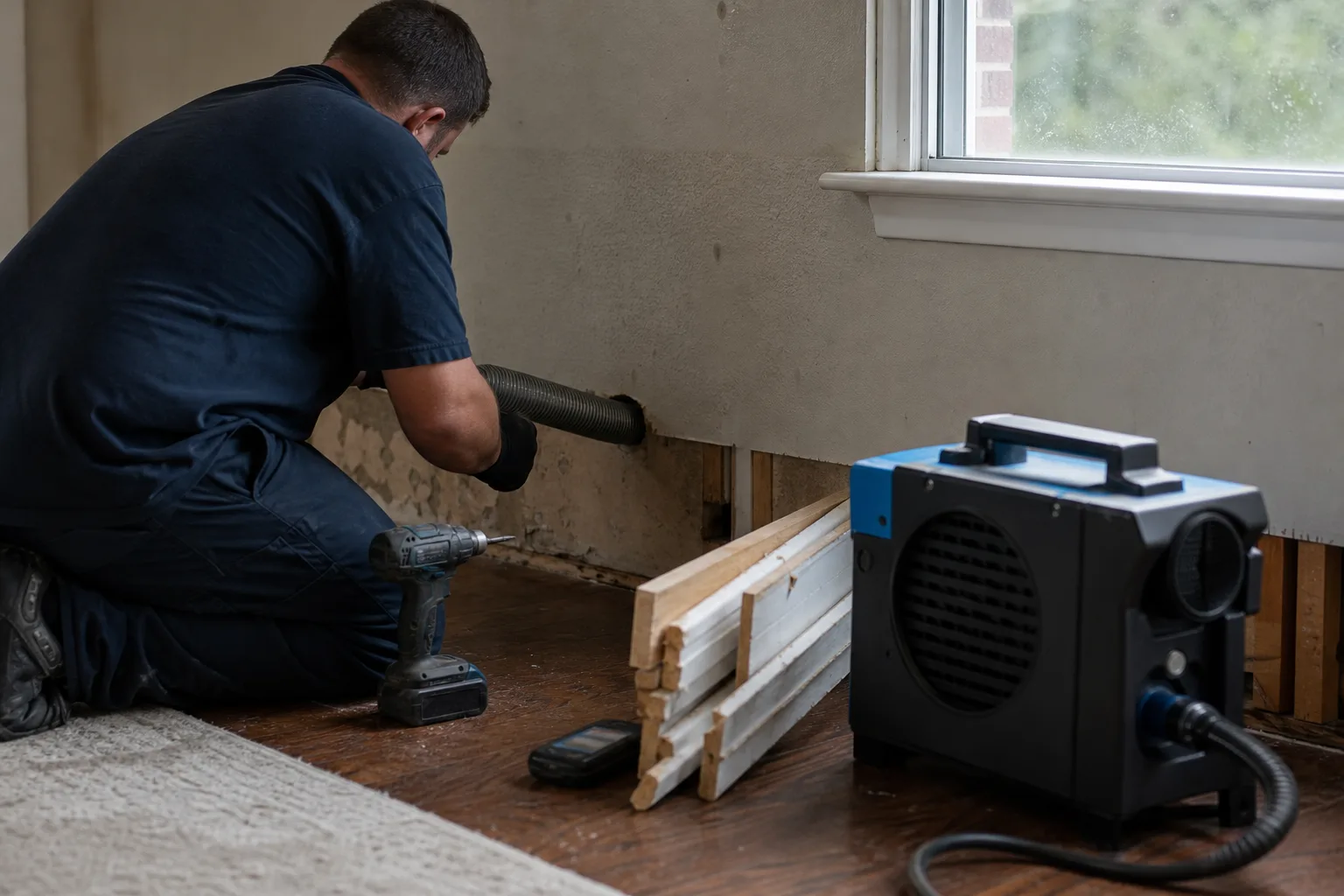
Holes drilled low on the drywall, often behind the baseboard, open the cavity.
- Cavity air injection
Tubes feed dry air from a dehumidifier into the ports so the studs dry from inside.
Make a list of the walls that smell or feel cool, and say which side of the house took the most rain.
Local detail
Aging wrap behind postwar stucco
West Chula Vista's postwar homes are largely single-story stucco built from the 1950s through the 1970s, so the original wrap behind your stucco may be decades old. After a winter storm, walk the outside and note any cracks near the walls that smell damp inside, then describe them on the call.
Phase order
Reading the wall until it holds steady
Your wall cavities dry slower than your open rooms because the air inside barely moves. The order runs from mapping, to opening ports, to injecting dry air, with readings at the same marked spots each visit.
Drying ends when those spots match a dry interior wall in your home and stay there through the next spell of damp weather. If the readings jump after the next rain, the stucco or the wrap still lets water in, and that opening needs envelope work before the wall can finish.
Triage order
When the drywall has to open up
Small ports are enough when your readings fall steadily. If the drywall turns soft, the insulation inside is soaking, or the readings stall, a larger opening lets the cavity dry and lets you see the framing. Readings, not guesswork, decide whether a wide opening is needed.
Scope: Emergency extraction and structural drying clearance only. Structural rebuild and finishing carpentry are contracted separately.
Service area
Chula Vista ZIP codes
- 91909
- 91910
- 91911
- 91912
- 91913
- 91914
- 91915
- 91921
Every responding technician is independent. Before work begins, confirm the technician's license, insurance and pricing with them directly.
Common questions
Wet wall questions
Can a thermal camera see water through a wall?
It sees temperature, not water. Wet areas usually read cooler because evaporation draws heat from them, so confirm every cool spot with a meter.
Do the small holes in the drywall stay?
Patching the ports is finish work, separate from the drying. The holes stay small and often sit behind the baseboard, so they cover easily.
Why does the room smell musty when the wall looks fine?
Wet wood and gypsum inside the cavity give off that odor even when both faces look dry. Treat the smell as a reason to call about mapping, not something to cover with air freshener.
What should you report about wet walls on a San Diego County call?
Say which walls smell or feel cool, whether the stucco has cracks, when the storm hit, and whether any outlet on that wall feels warm or trips the breaker.
Water damage keeps spreading until it is dried.
Call and describe the damage in Chula Vista: where the water came from, what is wet and how long it has been there.