Drying is a contest of vapor pressure. Wet materials give up moisture only when the air around them is drier than they are, so the goal is to keep the room air warm and dry while moving it steadily across every wet surface.
Service · Chula Vista, CA
Structural Drying and Dehumidification in Chula Vista, CA
The standing water is gone, but your baseboards still feel damp, the drywall is soft at the bottom, or the room smells musty when you walk in. Structural drying and dehumidification remove the water that soaked into the building itself: the wall cavities, the bottom plates, the subfloor and the concrete under your Chula Vista home. Keep the room closed, leave wet materials in place, and call to set up moisture mapping.
What you are seeing
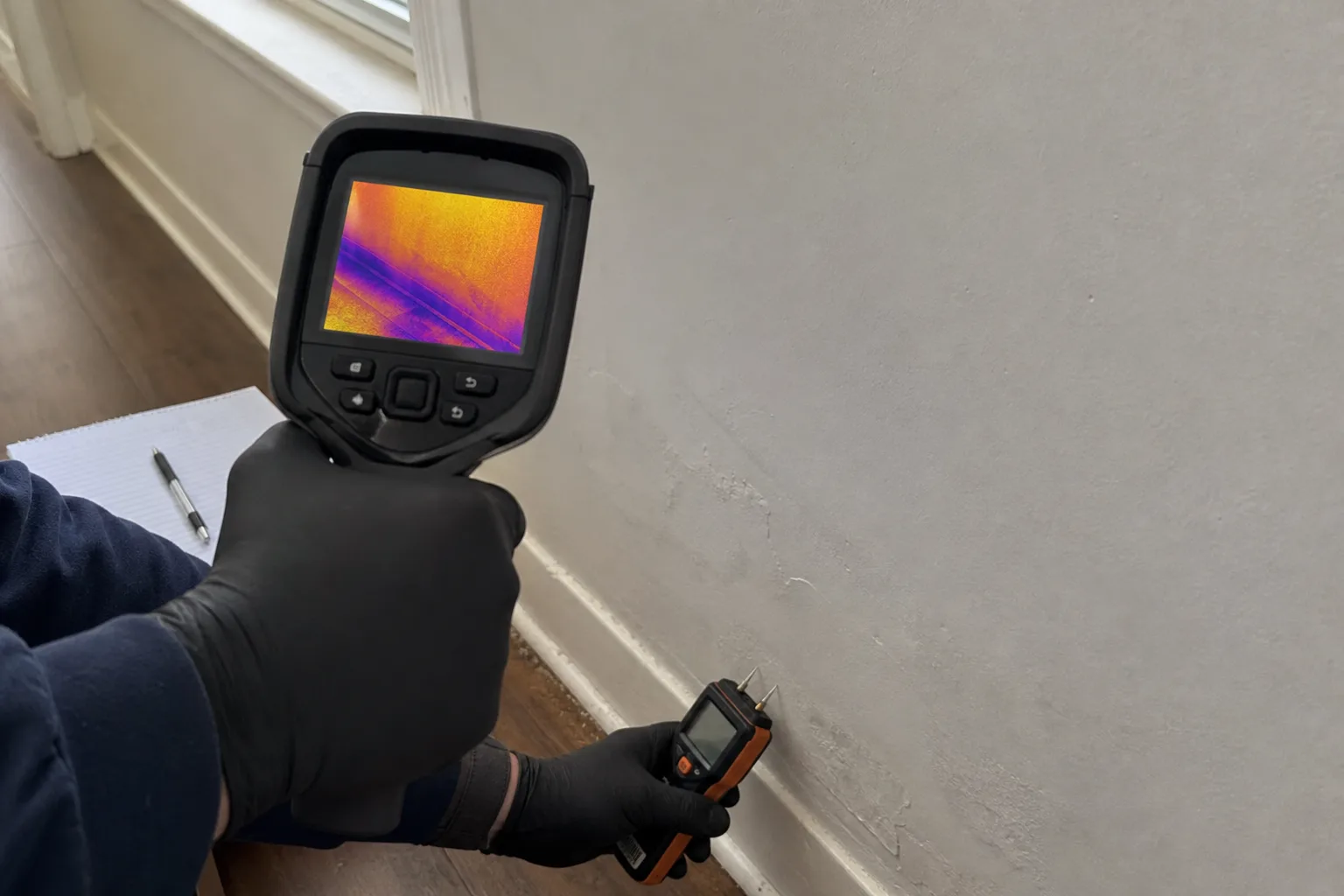
Damp walls after the puddle is gone
You mopped up, ran a fan, and the floor looks fine. Yet the paint at the base of the wall is bubbling, the baseboard has pulled away, or a closet smells stale. Those signs mean water is still inside the structure, and it will keep damaging wood and gypsum until something pulls it out.
- Swelling trim
Baseboards and door casings that bow or split at the bottom.
- Soft drywall
A wall that gives under your thumb near the floor.
- Lingering odor
A musty smell that comes back after you air the room out.
How it works
How water leaves wood, gypsum and concrete
Air movers break up the damp layer of air that clings to a wet wall. Dehumidifiers then pull that moisture out of the room before it can soak back in, and the drier the air, the harder the materials push water out.
If your walls still feel damp after the water is gone, keep the room closed and call to start structural drying.
(619) 927-7782Technique
Inside a drying chamber
- Chamber setup
Doors and vents to the wet area are closed or sheeted off so the equipment works on a small volume of air.
- Air movers
Angled low along the walls and across the floor so air sweeps the base of every wet surface.
- Dehumidifiers
Low-grain refrigerant or desiccant units sized to the room volume and the amount of wet material.
- Cavity drying
Small holes near the base of a wall, or a lifted baseboard, let dry air reach the framing behind the drywall.
- Psychrometric readings
Temperature and humidity logged inside and outside the chamber to confirm the air is pulling water.
You can help by keeping doors closed, leaving the equipment running and switched on, and keeping windows shut unless someone asks you to open them.
Phase order
How the readings set the schedule
The first set of readings maps every wet material. After that, a new set at each visit tracks progress, and the equipment moves as some areas dry and others lag.
Across San Diego County homes the pattern holds: thin drywall and carpet give up water first, framing takes longer, and concrete is the slowest of all.
The drying ends when each material matches the readings of a dry room in your home, not on a date fixed in advance.
Local detail
Concrete under west Chula Vista homes holds water
Much of west Chula Vista went up in the 1950s through the 1970s as single-story homes on concrete slab-on-grade foundations, and a slab soaks up water and releases it slowly. If your home sits on a slab, restoration protocol measures the concrete itself, not just the drywall, before any flooring goes back down.
Triage order
Signs the structure is still wet
Call back if a reading stops dropping, if the musty smell returns, or if new staining appears higher on a wall. Each one points to water still trapped somewhere or a leak that never fully stopped, and drying around it only delays the real fix.
Scope: Emergency extraction and structural drying clearance only. Structural rebuild and finishing carpentry are contracted separately.
Service area
Chula Vista ZIP codes
- 91909
- 91910
- 91911
- 91912
- 91913
- 91914
- 91915
- 91921
Every responding technician is independent. Before work begins, confirm the technician's license, insurance and pricing with them directly.
Common questions
Structural drying questions
Why not just open the windows?
Outside air is often damper than the air a dehumidifier produces, so open windows can slow the drying. Keep them closed unless someone reading the humidity asks you to open them.
Can you turn the equipment off at night?
Leave it running. Every time the air movers and dehumidifiers stop, the room air turns humid again and the materials stop giving up water.
Will the drywall have to come out?
Not always. Clean-water drywall that is still firm can often dry in place with cavity drying, while drywall that crumbled or soaked up sewage usually has to be cut out.
What should the final readings show?
Each wet material should read the same as the matching material in a dry room of your home. Final clearance readings come before any wall is closed or flooring goes back down.
Water damage keeps spreading until it is dried.
Call and describe the damage in Chula Vista: where the water came from, what is wet and how long it has been there.