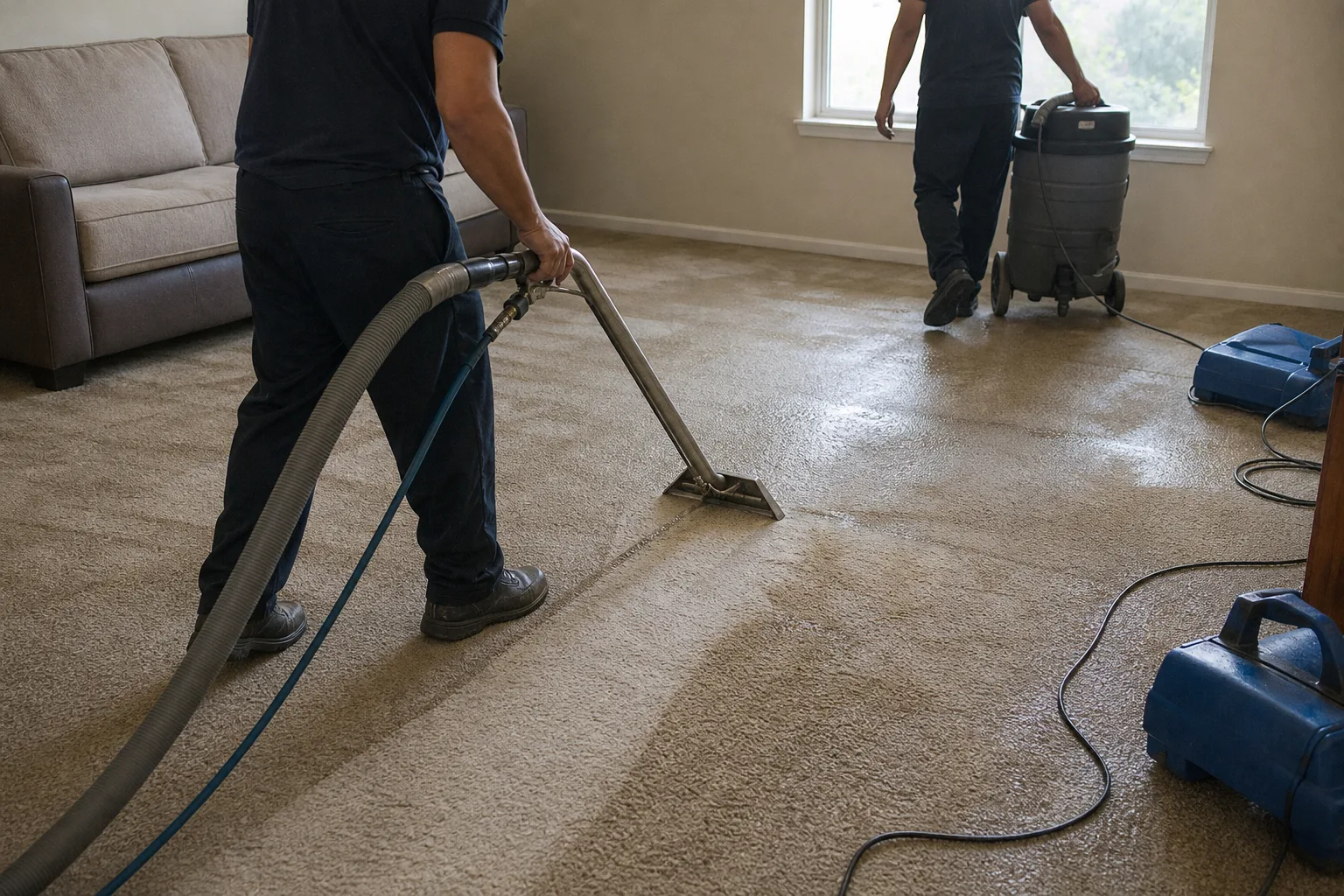
Liquid water and water vapor need different tools. Extraction equipment lifts the bulk liquid out of carpet, pad and hard floors, and every gallon it removes is a gallon your drying equipment never has to evaporate.
Service category · Chula Vista, CA
Water Extraction and Drying in Chula Vista, CA
Water is standing on your floor, soaking through the carpet, or creeping up the base of a wall. Water extraction lifts out the liquid, and drying draws out the moisture that has already moved into your Chula Vista home, so the work runs in that order. Stop the leak at its valve, keep clear of anything plugged in, and call to describe how much water you see.
What you are seeing
Three questions that size the problem
Before you call, answer three questions. Your answers tell the person on the line how much equipment the job needs and how the water has to be handled.
- How much water
A thin film on tile is a different job from an inch across a hallway or water pooled at ankle depth in a garage.
- How long it has sat
Water you found this morning behaves differently from water that soaked in overnight or since yesterday.
- What kind of water
A broken supply hose, a backed-up drain and runoff from outdoors each carry different risks, so tell which one you have.
- Where it went
Name each room, closet and hallway the water touched, including the ones that only look damp.
If the water touches outlets, cords or anything plugged in, or a ceiling above it is sagging, keep everyone out of that room and call from somewhere dry.
Choose your situation
Choose the situation that matches yours
- Emergency Water RemovalA burst line, a failed water heater or storm water across the floor: stop the flow and get standing water out.
- Structural Drying and DehumidificationThe puddle is gone but the walls stay damp: pull the hidden water out of drywall, framing and concrete.
- Wet Carpet and Flooring DryingSquishing carpet, a soaked pad or flooring lifting at the seams: protect the floor before the pad sours.
- Ceiling and Wall Water DamageA ceiling stain, bubbling paint or a soft wall: clear the room below and find out how much water sits inside.
- Coastal Humidity and Condensation DryingFogged windows, clammy walls or a damp closet: separate condensation from a leak and dry the air.
- Hardwood Floor Water DamageCupping boards, dark stains along the grain or a floor buckling near a wall: dry the wood before it locks in its new shape.
- Drywall and Insulation Water DamageChalky drywall, a climbing water line or wet insulation behind a wall: find out how high the water reached inside.
- Concrete Slab and Subfloor DryingA dark, damp slab under lifted flooring or a stain that keeps returning: dry the concrete before anything covers it.
- Air Movers and DehumidifiersRoaring air movers and humming dehumidifiers after a leak: what each one does and why they stay on.
- Cabinet and Vanity Water DamageA swollen sink-cabinet floor, a bubbling vanity base or water behind the toe-kick: stop the slow leak first.
- Attic Water DamageMatted insulation, a dripping fixture or stained rafters above you: stop the water before the room below takes it.
- Laminate and Vinyl Floor Water DamageLaminate peaking at the seams or water oozing between vinyl planks: get the water out from under the floating floor.
If water is still standing on your floor, stop the leak at its valve, keep clear of wiring, and call to describe it.
(619) 927-7782How it works
Liquid first, vapor second
Once the liquid is gone, air movers sweep the damp surfaces so moisture evaporates, and dehumidifiers capture that vapor before it settles back into gypsum and lumber. Skip extraction and you spend a long stretch evaporating water a pump could have lifted out at the start.
Technique
Each material gives up water at its own rate
Your home is a mix of materials, and each one holds water differently. Knowing which ones got wet helps you describe the damage.
- Tile and sealed surfaces
Water sits on top, so extraction removes most of it, though grout lines and gaps along the edges can let it underneath.
- Carpet and pad
The fibers release water readily, while the foam pad holds it flat against the subfloor.
- Drywall and trim
Gypsum wicks water upward from the floor, so the damp line can rise well above any puddle.
- Cabinets and toe-kicks
Particleboard swells once water reaches it, so tell the person on the call whether your kitchen or bathroom cabinets sit in the wet area.
- Concrete
A slab absorbs water slowly and releases it slowly, so it is often the last material to finish.
Drying metrics
Proof that the drying is finished
Your floor can look fine while the lower edge of a wall still holds water. Standard drying protocol takes moisture readings at the start, as the work progresses and at the end, measured against the same material in a room the water never reached.
Drying is finished when the wet materials match that reference, not when the equipment has run for a set period. A number that stalls points to a hidden leak or a closed cavity still feeding it.
Local detail
Marine air slows drying along San Diego Bay
Along the coast and bay in San Diego County, a marine layer of cool, moist air settles in much of the year, so wet rooms in Chula Vista give up their water slowly. Do not count on open windows to dry a wet room; mechanical drying guided by moisture readings does that work.
Triage order
Why a prompt call keeps the job smaller
Water keeps traveling after you stop seeing it: under trim, into the framing of your walls and along the seams of your flooring. Each extra room it reaches adds more material to dry.
When you call promptly, extraction can begin while most of the water is still liquid and close to where it entered. Stop the leak, keep the room clear, and call to describe the damage in your Chula Vista home.
Scope: Emergency extraction and structural drying clearance only. Structural rebuild and finishing carpentry are contracted separately.
Service area
Chula Vista ZIP codes
- 91909
- 91910
- 91911
- 91912
- 91913
- 91914
- 91915
- 91921
Every responding technician is independent. Before work begins, confirm the technician's license, insurance and pricing with them directly.
Common questions
Questions about extraction and drying
Can you dry the house yourself with fans and towels?
Towels and a box fan handle a small splash on tile. Once water has soaked carpet pad, gypsum or the bottom of a wall, a fan moves air across the surface without drawing water out of the material, so moisture mapping is what shows how far it went.
Do wet materials always have to come out?
No. Firm drywall, framing and carpet wet with clean water can often dry where they are, while anything soaked by sewage or runoff is usually cut out and discarded.
What should you say first when you call?
Say where the water came from, whether it is still running, how deep it is, and which rooms it reached. Mention any odor, because foul water changes how the work goes.
Does clean water stay clean if it sits?
No. Water from a supply line picks up dirt and residue from flooring and building materials the longer it stands, which is one more reason to start extraction promptly.
Water damage keeps spreading until it is dried.
Call and describe the damage in Chula Vista: where the water came from, what is wet and how long it has been there.