Concrete is full of tiny pores and capillaries. Water fills them from the top or from below, and it can only leave by moving back up to the surface and evaporating, one thin layer at a time.
Service · Chula Vista, CA
Concrete Slab and Subfloor Drying in Chula Vista, CA
You pulled back the flooring and the concrete underneath is still dark, cool and damp, or a stain keeps reappearing in the same spot on your floor. Concrete slab and subfloor drying is the slowest part of any water loss, because a slab soaks water deep into its pores and gives it back slowly. Keep new coverings off the floor, leave it exposed, and call about slab drying in your Chula Vista home.
What you are seeing
Dark concrete under the flooring
A wet slab gives off a few clear signs once the covering is up, and a few subtle ones while it is still down:
- Darker patches
Concrete that looks darker than the rest of the floor is still holding water.
- White powder
Mineral salts left on the surface as water migrates up through the concrete.
- Lifting adhesive
Glue under tile or vinyl that has turned soft, stringy or loose.
- A returning stain
The same spot on carpet or vinyl darkens again after it seemed dry.
How it works
Why a slab holds water so long
Any covering on top slows that escape. Vinyl, glued tile and even carpet pad trap the moisture, so a slab that stays covered can stay wet underneath long after the room feels normal.
If the concrete under your flooring still looks dark and damp, keep it uncovered and call about drying the slab.
(619) 927-7782Technique
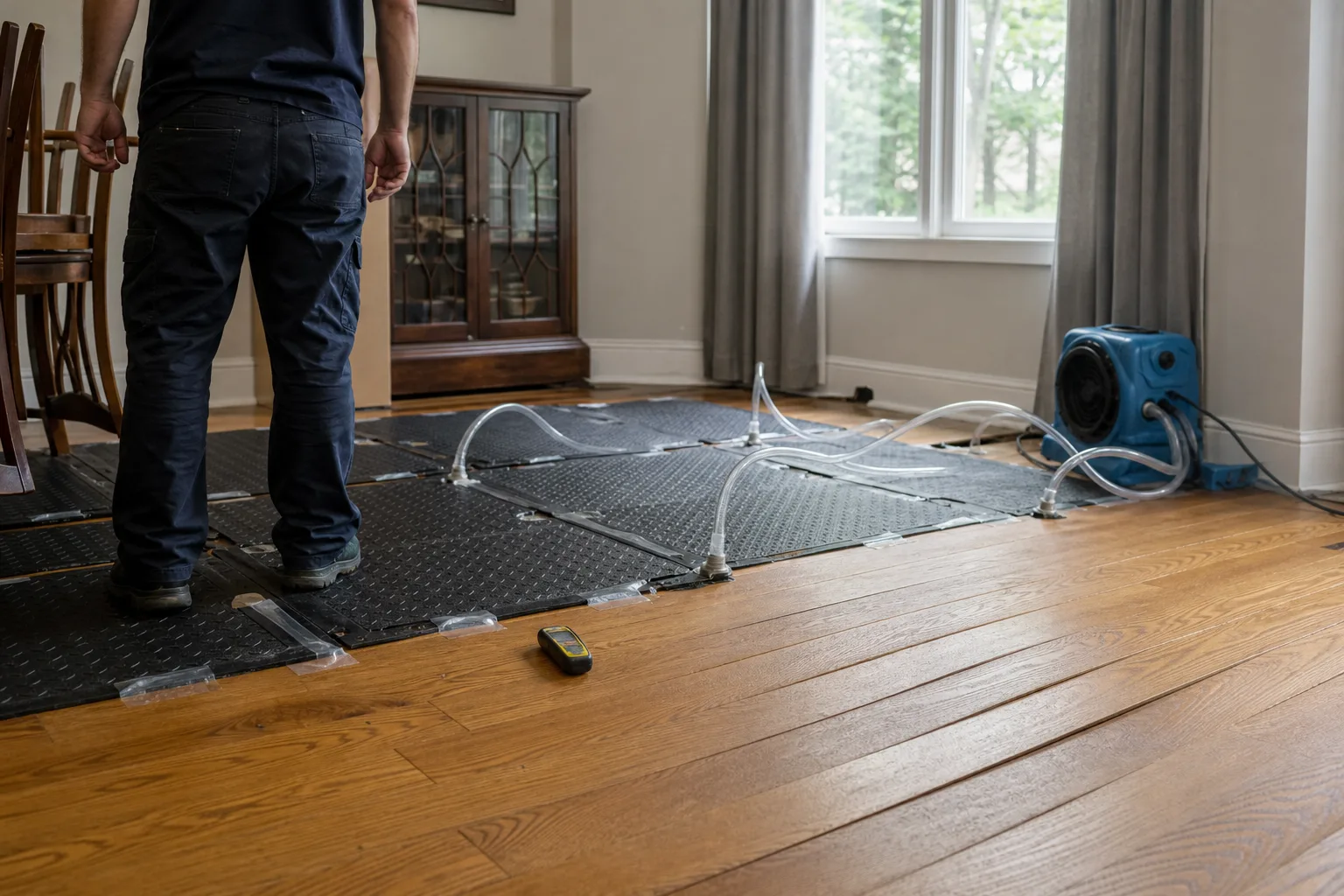
Exposing and drying the concrete
- Expose the surface
Wet carpet, pad and floating floors come up so the concrete can breathe.
- Low humidity overhead
Dehumidifiers keep the air above the slab dry, which pulls water out of the pores.
- Gentle heat
Raising the surface temperature speeds evaporation from the concrete.
- Slab readings
Surface meters and relative humidity probes set into the concrete show how much water is left at depth.
Plywood or wood strips over the slab are a second layer to dry. If your floor has them, say so, because the wood and the concrete both need readings.
Phase order
The last material to reach its goal
In most water losses, the drywall and framing finish well before the concrete. The order runs from stopping the source, to removing coverings, to steady drying with slab readings taken at each visit.
The slab is ready only when its readings meet the moisture limits for the flooring you plan to put back, which are stricter for glue-down vinyl and wood than for carpet. Laying a new floor on a slab that still reads wet invites adhesive failure and odor.
Local detail
Copper lines run in or under the slab
Much of west Chula Vista was built out in the 1950s through the 1970s on slab-on-grade foundations, with copper supply lines run in or under the concrete. When a slab stays wet with no spill above it, say what you noticed first so moisture mapping can cover the whole floor; the line itself needs a plumber.
Triage order
Leak under the slab or water from above
If water seems to rise from the concrete with no spill above it, or a warm patch shows up on the floor, a line under the slab may be leaking. Drying cannot finish until that line is found and fixed, and locating and fixing it is plumbing work separate from the drying.
Scope: Emergency extraction and structural drying clearance only. Structural rebuild and finishing carpentry are contracted separately.
Service area
Chula Vista ZIP codes
- 91909
- 91910
- 91911
- 91912
- 91913
- 91914
- 91915
- 91921
Every responding technician is independent. Before work begins, confirm the technician's license, insurance and pricing with them directly.
Common questions
Slab and subfloor questions
Can you put flooring back once the slab looks dry?
Not on looks alone. The surface dries first, so slab clearance relies on relative humidity readings at depth that meet the limit for the flooring you choose.
Why does the drying take longer than the walls?
Concrete is dense and thick, and water can only leave through its top surface. Drywall and studs lose water from more sides and much thinner sections.
Is white powder on the concrete a problem?
It is mineral salt carried up by the water as it leaves. It tells you moisture is moving, so mention it on the call.
What does the person on the call need to know about your San Diego County slab?
Say whether your home sits on a slab, what covered the floor, where the water came from, and whether you noticed a warm spot or a meter that keeps turning.
Water damage keeps spreading until it is dried.
Call and describe the damage in Chula Vista: where the water came from, what is wet and how long it has been there.