Wind blowing against your house raises the air pressure outside, and that pressure drives rain into any gap you have: a shrunken glazing seal, flattened weatherstripping or a cracked bead of caulk around the frame.
Service · Chula Vista, CA
Window and Door Leaks in Storms in Chula Vista, CA
Rain is running down the inside of your window glass, water is pooling on your sill, or a puddle forms at your sliding door whenever the wind picks up. Window and door leaks in storms happen when wind drives rain past your worn seals, weatherstripping and the drainage channels in each frame. Towel the sill and threshold, move your curtains and floor mats clear, and call to describe which openings leak in your Chula Vista home.
What you are seeing
Water at the glass, the sill and the threshold
Storm leaks at openings show up in a few telltale places. Check each of your windows and doors on the side of the house facing the wind:
- Sill pooling
Water collecting on the inside sill and dripping over the edge.
- Track overflow
The bottom track of a slider filling and spilling onto the floor.
- Damp drywall below
Stains or soft spots under the lower corners of a window.
- Wet carpet at the door
A damp strip of carpet or swollen laminate just inside the threshold.
- Lifting paint at the corners
Bubbles or cracks at the upper corners of a frame where water ran behind it.
If rain is getting in at a window or door, towel the sill and threshold, roll rugs back, and call to describe the leak.
(619) 927-7782How it works
How wind pushes rain through a closed window
Window and slider tracks have small weep slots that let water out. When dirt or insects clog them, the track fills like a gutter and overflows inward, and water that gets behind the frame can run down inside the wall below the sill.
Technique
Checking the wall under each opening
- Sill and jamb readings
A moisture meter checks the drywall and trim around each opening and down to the floor.
- Corner focus
The lower corners of the frame get the closest look, since water collects there first.
- Track clearing
Silt and debris come out of the tracks and weep slots so standing water can drain.
- Targeted drying
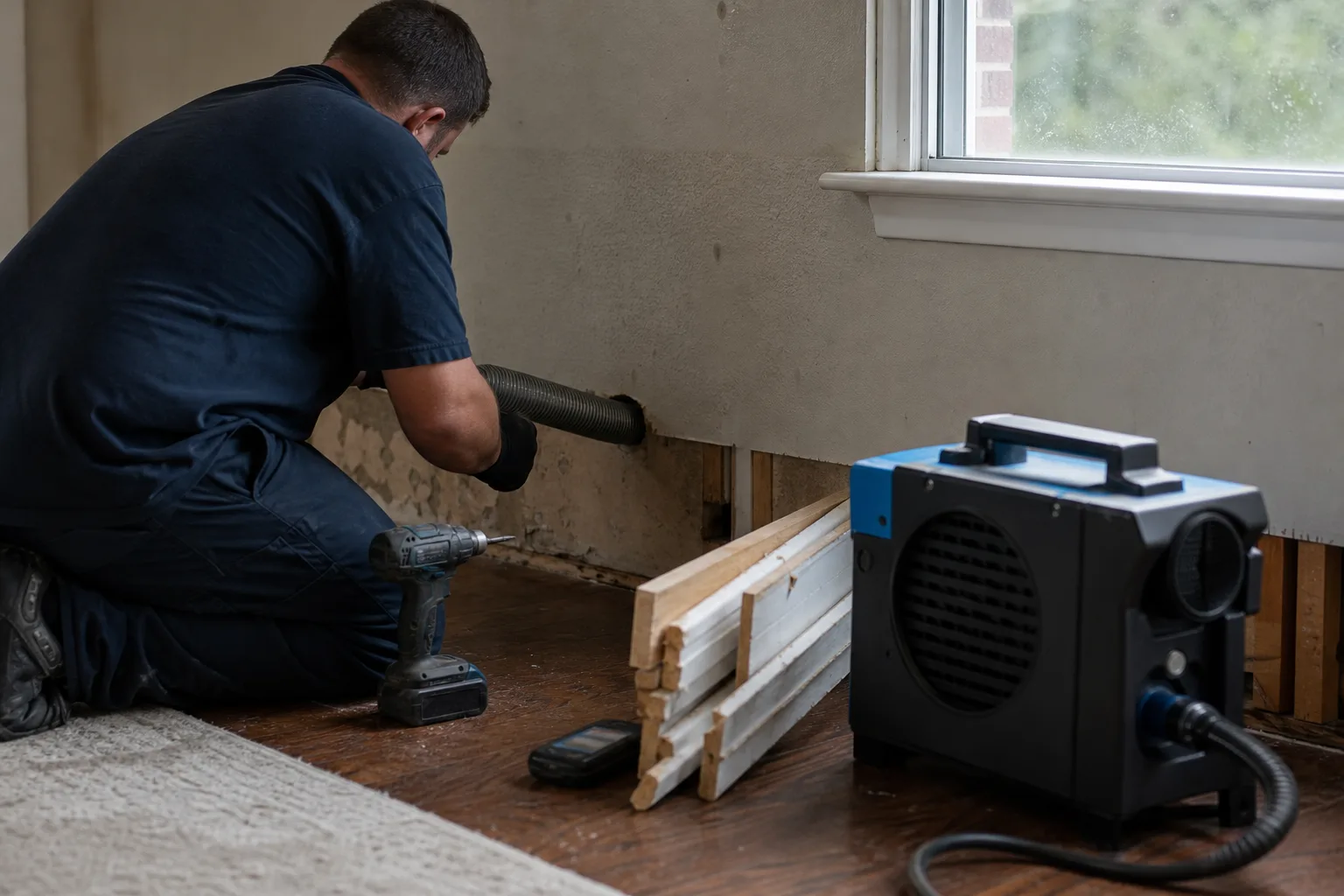
Air movers and a dehumidifier focus on the wall below each wet opening.
Resealing frames, swapping glazing and fitting new weatherstripping are window and door work, separate from the drying. Note which of your openings leaked so that work goes to the right ones.
Phase order
Towels now, seals next, drying last
Towels and a shallow pan can hold off sill pooling during the storm, but they do nothing for water already inside the wall. Once the rain stops, the order runs from clearing the tracks, to readings under each opening, to drying the wet sections.
A leak you catch on the first wet day usually leaves a small damp patch under one corner. Leaks you let run through several storms can soak the framing below the sill and spread along the floor.
Local detail
Seals that have seen decades of sun
Much of Chula Vista's housing went up in the decades after the war, so the glazing seals and weatherstripping on older windows and sliders have often baked through many dry summers. If an opening has leaked before, watch it at the start of every winter storm and mention its age on the call.
Documentation
Write down which openings leak
- Window by window
Number each window and door and note which ones leaked.
- Wind direction
Note which side of the house the storm hit hardest.
- Water path
Photograph water on the glass, on the sill and on the floor below.
- Track condition
Photograph debris in the tracks before you clean them.
- Towel count
Jot down how often you wrung out towels or emptied a pan at each opening.
Scope: Emergency extraction and structural drying clearance only. Structural rebuild and finishing carpentry are contracted separately.
Service area
Chula Vista ZIP codes
- 91909
- 91910
- 91911
- 91912
- 91913
- 91914
- 91915
- 91921
Every responding technician is independent. Before work begins, confirm the technician's license, insurance and pricing with them directly.
Common questions
Window and door leak questions
Why does the leak only happen in some storms?
Wind direction and strength decide which side of the house takes the rain. An opening facing a strong wind has more pressure behind the water than one on the sheltered side.
Should you caulk around the frame during the storm?
Caulk does not stick to a wet frame. Keep towels and a pan in place until the rain stops, then let the frame dry before any sealing.
Can water from a window reach the floor inside the wall?
Yes. Water that gets behind the frame runs down the inside of the wall and can wet the bottom plate and the floor edge below.
What should you note about leaking windows on a San Diego County call?
Say which openings leak, which way they face, whether water reaches the floor, and whether the drywall below feels soft.
Water damage keeps spreading until it is dried.
Call and describe the damage in Chula Vista: where the water came from, what is wet and how long it has been there.